

🎮 What Are Roguelike Games? A Complete Guide

Roguelike games can feel confusing when you first see the term. One game may use random dungeons, turn based combat, and permanent death, while another uses fast combat, cards, or platforming and still gets called a roguelike. Games such as Hades, Dead Cells, and Balatro show how much the genre has changed since its early computer game roots.
The name comes from Rogue, a game created around 1980 that became the main reference point for the genre. Traditional roguelikes often use procedural generation, permadeath, turn based play, grid movement, exploration, resource management, and tactical decisions. Modern games borrow some of these ideas and mix them with action, cards, platforming, shooting, survival, or strategy. This guide explains what roguelike games are, where they came from, what the Berlin Interpretation means, how roguelikes differ from roguelites, and how to choose one as a beginner.
🎮 Roguelike Games at a Look
Roguelike games are built around repeated runs, changing challenges, and meaningful choices. Traditional roguelikes often use several classic features, while modern games may mix these ideas with action, cards, platforming, shooting, or strategy.
| Feature | What It Means |
|---|---|
| Random generation | Some parts of a run can change each time you play. |
| Permadeath | Death can end the current run and require a new attempt. |
| Repeated runs | You play again after a run ends and use what you learned. |
| Resource management | You decide how and when to use limited items or resources. |
| Traditional style | Often uses turn-based play, grid movement, exploration, and complex systems. |
| Modern style | May use real-time combat, cards, platforming, shooting, or permanent upgrades. |
🎮 What Are Roguelike Games?
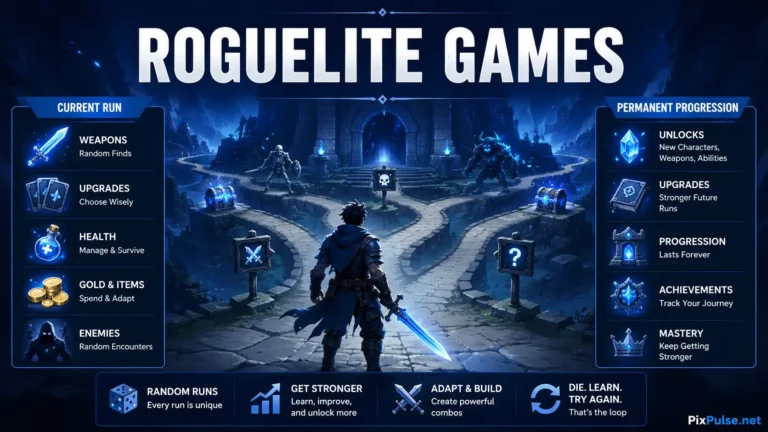
Roguelike games are generally built around repeated runs, changing challenges, meaningful choices, and learning from failure. During a run, you may explore an area, fight enemies, collect items, choose upgrades, manage resources, and work toward a final goal.
Traditional roguelikes usually include several features associated with the genre. These can include random environment generation, permadeath, turn based gameplay, grid based movement, exploration, resource management, and tactical play.
Modern roguelikes can look very different. Some use real time combat instead of turns. Others focus on cards, platforming, shooting, survival, or strategy. The shared idea is often a run based structure in which players must adapt to changing situations.
The term has also become broader over time. That is why two games can both be called roguelikes even when their gameplay looks very different.
👥 Who Are Roguelike Games For?
Roguelike games can suit many types of players.
If you enjoy careful planning, a traditional turn based roguelike gives you time to think before making a move. If you prefer fast combat, an action roguelike may be a better fit.
Card game fans can try deckbuilding roguelikes. Players who enjoy platforming can choose games that mix changing runs with movement and exploration.
The genre can also suit players who enjoy replayability, difficult challenges, resource management, and testing different builds.
You do not have to start with a classic game. A modern roguelite with clear controls and permanent progression can provide an easier introduction.
🕰️ Where Did Roguelike Games Come From?
The name roguelike comes from Rogue, a computer game created around 1980. Rogue became the namesake and a major reference point for the genre.
Some ideas linked with roguelikes appeared before Rogue. Beneath Apple Manor was released in 1978 for the Apple II and used a randomly generated dungeon. It is often discussed as an early predecessor to the genre and predates Rogue by two years.
It is safer to describe Beneath Apple Manor as an early roguelike predecessor rather than claim that it was definitely the first roguelike. The answer depends on how someone defines the genre.
Rogue later became the main reference point. Games such as NetHack, Angband, ADOM, and Crawl helped develop the traditional roguelike style.
The Berlin Interpretation came much later, in 2008. It was created as a way to describe characteristics linked with traditional roguelikes. It did not create the genre or establish a strict rulebook for every game.

🧩 What Makes a Game a Roguelike?
There is no single feature that decides whether a game is a roguelike.
A traditional roguelike often combines several systems. Random environments can make each run different. Permadeath can make decisions carry more weight. Turn based play can give players time to plan. Grid movement can make positioning important.
Other common features include exploration, resource management, tactical choices, and complex interactions between game systems.
The Berlin Interpretation is one of the main historical references used when discussing these features.

🎲 Why Do Roguelike Games Use Randomness?
Randomness gives each run a different set of situations to solve. A randomly generated map, item placement, enemy placement, or encounter can change how you approach the same game.
The goal is not to make the game completely unpredictable. Developers set rules that control how the random systems work, so players can still make informed decisions. The Berlin Interpretation specifically connects random environment generation with replayability.
This is one reason roguelike games can stay interesting after many failed runs. You learn the game’s systems while facing new combinations of challenges.

📜 What Is the Berlin Interpretation?

The Berlin Interpretation is a framework for describing traditional roguelike games.
It was developed during the International Roguelike Development Conference in Berlin in 2008. The goal was to help the roguelike community describe and discuss the genre. It was not intended as a rulebook that every developer had to follow.
The framework separates characteristics into nine high value factors and six low value factors.
🧠 The Nine High Value Factors
The Berlin Interpretation lists these nine high value factors:
- Random environment generation
- Permadeath
- Turn based gameplay
- Grid based gameplay
- Non modal gameplay
- Complexity
- Resource management
- Hack and slash combat
- Exploration and discovery
These factors describe features strongly associated with the traditional roguelikes used as examples in the interpretation. They are useful for comparing games, but they do not work as a simple pass or fail test.
📋 The Six Low Value Factors
The six low value factors are:
- Single player character
- Monsters similar to the player
- Tactical challenge
- ASCII display
- Dungeons
- Numbers
The term low value does not mean these features are bad. It means the Berlin Interpretation gives them less weight when comparing games with the traditional roguelike model.
This creates two useful points for beginners.
ASCII graphics are not required. A game does not need text characters to be a roguelike.
Dungeons are not required either. Dungeons appear frequently in traditional roguelikes, but the Berlin Interpretation places them in the low value group.
Resource management deserves special attention because it is a high value factor, not a low value one.
Tactical decisions are also common in traditional roguelikes, but Tactical Challenge is listed as a low value factor in the Berlin Interpretation.
🎮 The Five Canon Games
The Berlin Interpretation uses five games as its canon:
- Rogue
- NetHack
- Angband
- ADOM
- Crawl
These games are useful reference points because they represent the traditional form of the genre.
The Berlin Interpretation should be viewed as a historical framework rather than a strict test. A game does not need every listed feature to be discussed as a roguelike.
🎲 What Is Procedural Generation?
Procedural generation creates some game content through rules and algorithms.
A new run may have different rooms, maps, item locations, enemy positions, rewards, or encounters. The exact system depends on the game.
This does not mean that everything happens without rules. Developers create systems that control what can appear and how different parts of the game fit together.
The result is a game that can provide different situations across repeated attempts.
Procedural generation can also create surprises. A player may find a useful item early in one run and struggle for resources in another.
💀 What Is Permadeath?
Permadeath means that death ends the current run.
In a traditional roguelike, you usually cannot load a recent save and continue from the exact moment your character died. You start another attempt instead.
This makes choices more meaningful. A risky fight may offer a valuable reward, but losing can end a strong run.
Modern roguelites often change this formula. You may lose the progress made during a run but keep selected upgrades, characters, weapons, or other unlocks.
⏱️ What Is Turn Based Gameplay?
Traditional roguelikes commonly use turn based gameplay.
Your character takes an action, and the game responds. This gives you time to consider movement, attacks, items, positioning, and escape routes.
Turn based play can make even a simple movement decision matter. Moving one space may expose your character to an enemy or place you in a better position.
Modern roguelikes often use real time combat instead. This is one reason games such as Hades feel very different from classic roguelikes.
🧱 What Is Grid Based Movement?
Traditional roguelikes often use a grid where characters and objects occupy individual tiles.
Position can affect combat and exploration. Moving one tile may place you next to an enemy, block a path, or create a better attack position.
A modern game does not need to show an obvious grid. Some games use detailed graphics while keeping movement and positioning based on tile like systems.
Grid movement works especially well with turn based play because every move can become a tactical choice.
🗺️ What Role Does Exploration Play?
Exploration is a major part of traditional roguelike design.
A dungeon or other environment may contain rooms, corridors, enemies, traps, items, shops, and hidden areas.
Going farther can provide better rewards, but it can also create more danger.
Players often have to decide whether to continue exploring or return to a safer area. That decision becomes harder when health and other resources are limited.
🎒 Why Is Resource Management Important?
Resources can include:
- Health
- Food
- Healing items
- Weapons
- Ammunition
- Gold
- Mana
- Special abilities
You cannot always use everything as soon as you receive it.
Saving a healing item for a dangerous encounter may be better than using it after a small amount of damage.
Resource management is one of the high value factors in the Berlin Interpretation.
🧠 Why Do Tactical Choices Matter?
Roguelikes often ask players to make decisions with limited information.
You may need to decide whether to fight, retreat, use an item, change your route, or accept a risky reward.
A poor choice can end a run.
The next attempt gives you a chance to use what you learned and make a different decision.
🏛️ What Is a Traditional Roguelike?
A traditional roguelike follows many of the ideas associated with classic games such as Rogue, NetHack, Angband, ADOM, and Crawl.
Common features include:
- Turn based gameplay
- Grid based movement
- Random environment generation
- Permadeath
- Exploration
- Resource management
- Tactical decisions
- Complex systems
- Repeated runs
Traditional roguelikes often focus heavily on what happens during the current run rather than permanent upgrades between runs.
Examples include:
- Rogue
- NetHack
- Angband
- ADOM
- Crawl
- Dungeon Crawl Stone Soup
- Brogue
- Caves of Qud
One detail is worth keeping clear. The Berlin Interpretation’s canon lists Crawl, not Dungeon Crawl Stone Soup. Dungeon Crawl Stone Soup is a later game in the Crawl lineage.
🧪 What Is a Roguelite?
A roguelite borrows ideas from traditional roguelikes but changes part of the formula.
Many roguelites use:
- Repeated runs
- Changing environments
- Death and restart
- Permanent upgrades
- Real time combat
- Unlockable characters
- New weapons
- Meta progression
The player may lose most run specific progress after death but keep selected upgrades or unlocks.
Roguelite is also a broad community term rather than one strict technical category. Different developers, players, stores, and publications can use the term in slightly different ways.
📈 What Is Meta Progression?
Meta progression means some progress remains after a run ends.
For example, you may unlock a weapon, character, ability, route, or upgrade during one attempt. That unlock can then become available during later attempts.
Traditional roguelikes generally put more focus on the current run. Many modern roguelites add permanent progression between runs.
This can make repeated failure easier to accept because an unsuccessful run may still give you new options.
⚔️ Roguelike vs Roguelite
The main difference is how closely a game follows traditional roguelike design.
🔍 Traditional Roguelike vs Roguelite
| Feature | Traditional Roguelike | Roguelite |
|---|---|---|
| Turn-based play | Common | Less common |
| Grid movement | Common | Sometimes |
| Permadeath | Common | Often used, but may work with other progression systems |
| Random runs | Common | Common |
| Real-time combat | Less common | Common |
| Permanent upgrades | Less common | Common |
| Meta progression | Usually limited | Common |

A modern game can use several roguelike mechanics without following the traditional form. That is why game labels can vary between developers, stores, critics, and players.
🔄 What Are Roguelike Inspired Games?
Roguelike inspired games borrow selected ideas without following the traditional formula closely.
A platformer can use changing levels and repeated runs. A shooter can use procedural stages and permanent upgrades. A strategy game can use random encounters, resource management, and run based progression.
Spelunky 2 combines platforming, exploration, traps, enemies, and changing environments.
FTL: Faster Than Light takes a strategy approach. You manage a spaceship and crew while dealing with changing events, resources, enemies, and routes.
These games show how roguelike ideas can work outside traditional dungeon crawlers.
🎯 How Does a Roguelike Run Work?
A typical run starts with a basic character, limited resources, or a simple build.
You explore, fight enemies, collect items, select upgrades, and make route decisions. Depending on the game, maps, enemies, rewards, or available upgrades may change.
Your character can become stronger during the run while later challenges become harder.
A run may end when you reach the final goal or when your character dies.
A simple run loop looks like this:
Start → Explore → Fight → Collect → Build → Make choices → Face harder challenges → Win or die → Start again
The next run gives you another chance to apply what you learned.

🎲 Are Roguelike Games Based on Luck?
Roguelike games use randomness, but winning is not simply about luck.
Players learn enemy behavior, manage resources, choose routes, position their characters, and make decisions based on the information available.
A good roguelike gives you ways to adapt when a run does not provide your preferred item or build.
You may need to change your plan instead of waiting for the perfect combination.
This balance between randomness and player decisions is one reason repeated runs can remain interesting.
🌱 What Are Seeded Runs in Roguelike Games?
A seeded run uses a fixed random seed to reproduce the same basic sequence of generated content. This means two players using the same seed can encounter the same starting conditions, although their choices can still lead to different results.
Seeded runs can be useful for challenges, testing strategies, comparing builds, and sharing interesting game situations. They give players a way to repeat a particular randomly generated setup instead of starting with a completely different one.
🎯 Why Do Players Use Seeded Runs?
Seeded runs can make it easier to compare strategies because players can work with the same underlying generated setup. They can also help players share interesting runs, test builds, or attempt community challenges.
The exact behavior depends on the game. A fixed seed does not mean every player will have an identical experience because player decisions can change what happens during the run.
😈 Why Are Roguelike Games Difficult?
Roguelikes can be difficult because mistakes can have lasting consequences.
You cannot always reload a recent save to undo a poor decision. In traditional games with permadeath, death normally ends the current run.
Changing content can also make planning harder. You may not know which enemies, items, rooms, or rewards will appear.
A failed run can still teach you an enemy pattern, reveal a better route, or show why a particular upgrade did not work.
❤️ Why Do People Like Roguelike Games?
Replayability is one major reason.
A new run can produce different situations, rewards, routes, and builds. That gives players a reason to return after losing.
Learning is another part of the appeal. Players become more familiar with game systems while improving their own decisions.
Build experimentation adds another layer. Different items, cards, weapons, or upgrades can create different strategies.
🧩 Types of Roguelike and Roguelite Games

🏰 Traditional Roguelikes
These stay close to the classic formula.
They commonly use turn based play, grid movement, random environments, exploration, resource management, roguelike strategy and permanent consequences.
⚡ Action Roguelikes
These use real time combat and movement.
Hades is a major modern example. Its official Steam page describes it as a rogue like dungeon crawler, while its user defined tags include Action Roguelike and Roguelite.
The game combines repeated escape attempts with fast combat and progression between runs.
🃏 Deckbuilding Roguelikes
These combine card strategy with repeated runs.
You build or change a deck during each attempt while making decisions about battles, rewards, routes, and upgrades.
Slay the Spire is a major example.
Balatro is another. Its official Steam page calls it a poker roguelike and describes it as a poker inspired roguelike deck builder.
♟️ Tactical Roguelikes
These focus heavily on planning, positioning, resources, and careful choices.
They can suit players who prefer strategy over fast reactions.
🏃 Platform Roguelites
These combine platforming with changing runs and progression.
Dead Cells is a strong example. Its official Steam page describes it as a roguelite, Metroidvania inspired action platformer. It also uses permadeath and lets players keep some progression between runs.
👾 Survival Roguelikes
These often place the player against large groups of enemies while offering changing upgrades during a run.
Vampire Survivors is a well known example of this style.
🤝 Co-op Roguelike Games
Some modern roguelikes and roguelites support cooperative play.
Co-op changes the experience because players can share combat duties, combine builds, manage resources, and make decisions together.
Risk of Rain 2 is a well known example of run based action with cooperative play.
🌟 Popular Roguelike and Roguelite Games
| Game | Style | Main appeal |
|---|---|---|
| Hades | Action roguelike/roguelite | Fast combat and repeated escape attempts |
| Hades II | Action roguelike/roguelite | Run based combat and progression |
| Dead Cells | Roguelite action platformer | Platforming, combat, and changing routes |
| Slay the Spire | Deckbuilding roguelike | Cards and run based strategy |
| Balatro | Poker roguelike | Card combinations and deckbuilding |
| Risk of Rain 2 | Action roguelike | Shooting, items, runs, and co-op |
| Spelunky 2 | Platform roguelike | Exploration, traps, and unpredictable runs |
| FTL | Strategy roguelike | Crew management and random events |
These games show how broad modern roguelike design has become.
They do not all follow the traditional formula, but they use ideas associated with repeated runs, changing content, difficult decisions, and replayability.
🕳️ Other Roguelike Inspired Games
Spelunky 2
Spelunky 2 combines platforming, exploration, traps, enemies, and changing environments.
It shows how run based design can work with precise platforming rather than traditional turn based dungeon exploration.
The Binding of Isaac
The Binding of Isaac combines dungeon exploration, shooting, random items, and repeated runs.
It is a useful example of roguelike systems being used in a modern action game.
FTL: Faster Than Light
FTL takes a strategy focused approach.
You manage a spaceship and crew while dealing with changing events, resources, enemies, and routes.
Noita
Noita combines exploration, action, procedural environments, and physics based systems.
Its systems can create unexpected situations, giving each attempt a different feel.
👶 Are Roguelike Games Good for Beginners?
Yes, but some are easier to start with than others.
When choosing your first roguelike, check the combat style, run length, difficulty, progression system, and tutorial quality.
A game with clear controls and useful permanent unlocks may feel easier for a new player than a traditional roguelike with many interconnected systems.
A modern roguelite can be a good entry point because it may combine repeated runs with permanent unlocks and familiar real time controls.
Action fans may prefer Hades or Dead Cells. Players who enjoy careful planning may prefer a traditional turn based roguelike.
🎯 How to Choose Your First Roguelike
Before choosing a game, check five things:
- Combat style: Do you prefer turn based or real time combat?
- Run length: Can you finish a run within the time you normally have?
- Difficulty: Do you want a gentle introduction or a demanding challenge?
- Progression: Do you want permanent upgrades after death?
- Tutorial quality: Does the game explain its systems clearly?
This checklist can help you avoid choosing a game that does not fit your play style.
A strategy fan may enjoy a traditional turn based game. Someone who prefers fast action may have more fun with an action roguelite.

💾 How Does Saving Work in Roguelike Games?
Saving works differently between games.
Some traditional roguelikes use systems that prevent players from repeatedly loading a save to undo every mistake. Modern games can use checkpoints, run based saves, or other systems.
Saving a game is also different from keeping progress after death.
Before starting a long run, check how the specific game handles saves, quitting, death, and permanent upgrades.
📅 What Are Daily Runs and Challenge Runs?
Some roguelike and roguelite games offer daily or special challenge runs. These modes can give players a fixed scenario, specific conditions, or a shared challenge to complete.
Daily challenges can make a game more competitive because players may be working with the same basic setup. Challenge modes can also encourage players to try strategies they would not normally use.
These modes are optional features, not requirements for a game to be considered a roguelike.
✅ Quick Checklist for Choosing a Roguelike
Use these points before choosing your first game. The best starting point depends on the type of gameplay you enjoy.
📚 How Can Beginners Get Better at Roguelike Games?
Do not expect to win your first few runs.
Instead, look at why you lost. Maybe you took too much damage, used an item too early, selected a weak upgrade, or entered a dangerous fight without enough resources.
Then change one thing during your next run.
Learn enemy patterns and pay attention to which upgrades work well together.
You can also watch experienced players if you need another way to learn.
⏱️ Are Roguelike Games Good for Short Gaming Sessions?
Some are.
Roguelikes can fit shorter gaming sessions because they are built around individual runs.
However, run length varies greatly.
Before choosing a game for short sessions, check its run length and save system. Some games make it easier to stop and return later than others.
🧠 Are Roguelike Games Good for Strategy Fans?
Yes.
Many roguelikes ask players to manage health, choose routes, select upgrades, study enemies, and decide when to take risks.
Turn based roguelikes can suit players who like time to plan.
Deckbuilding roguelikes are another option for people who enjoy creating combinations and testing different strategies.
🤔 Are Hades, Dead Cells, and Balatro Really Roguelikes?
The answer depends on how broadly you use the term.
Under a traditional definition, these games do not follow every classic roguelike feature.
Hades uses real time combat and progression between runs. Its official Steam page calls it a rogue like dungeon crawler and includes Action Roguelike and Roguelite tags.
Dead Cells uses roguelite systems with action platforming and persistent progression.
Balatro focuses on poker inspired deckbuilding and explicitly describes itself as a poker roguelike.
So these games fit the broader modern use of roguelike and roguelite, but they should not be presented as strict traditional roguelikes.
🎯 How Can You Find a Roguelike That Fits Your Play Style?
Start with the type of gameplay you already enjoy.
| If you enjoy… | Look for… |
|---|---|
| Fast combat | Action roguelikes |
| Turn based strategy | Traditional roguelikes |
| Card games | Deckbuilding roguelikes |
| Platforming | Platform roguelites |
| Co-op games | Multiplayer roguelikes |
| Short sessions | Games with shorter runs |
| Deep systems | Traditional roguelikes |
| Persistent upgrades | Roguelites |
| Difficult games | Traditional roguelikes or harder roguelites |
This is a better way to choose a game than relying only on the label.
💻 Roguelike Games by Platform
Roguelike and roguelite games are available on PC and major consoles, with some titles also appearing on handheld and mobile platforms.
PC has a broad selection of traditional roguelikes, indie releases, and modern roguelites.
Before buying a game, check its current official store page for platform support, price, controller support, and other details.
Game availability can change, so current store information is more useful than an old recommendation list.
🤖 Can AI Tools Help You Find Roguelike Games?
AI tools can help you compare games based on your preferences.
You can ask for turn based roguelikes, beginner friendly games, deckbuilders, co-op options, or games with shorter runs.
You can also ask an AI tool to compare games by combat style, difficulty, progression, platform, and run structure.
For example:
Recommend five roguelike games for a beginner who likes turn based combat, short runs, simple controls, and character progression. Explain why each game fits.
You can then check official store pages and trusted reviews before buying.
AI can help organize choices and suggest possibilities, but current game details should still be checked against reliable sources.
❓ Frequently Asked Questions (FAQ’s)

🏁 Conclusion
Roguelike games stand out because each run can teach you something. A failed attempt can reveal an enemy pattern, show why a build did not work, or teach you when to take a risk. That cycle of playing, making decisions, failing, learning, and trying again is a major part of the genre.
The history also explains why the term can be confusing. Beneath Apple Manor appeared before Rogue and used procedural dungeon ideas, while Rogue later gave the genre its name and became its major reference point. The Berlin Interpretation arrived in 2008 as a framework for describing traditional roguelike features, not as a rulebook that every later game must follow.
Today, roguelike games can include traditional turn based dungeon crawlers, fast action games, deckbuilders, platformers, survival games, and strategy titles. If you are new to the genre, choose a game that matches your preferred play style instead of relying only on its label. Once you know how procedural generation, permadeath, progression, and repeated runs work, comparing roguelike games becomes much easier.

Bài chia sẻ chất lượng. Ai đang tìm hiểu du học Hàn Quốc có thể liên hệ Letco — hỗ trợ chọn ngành, học bổng và thủ tục visa nhanh gọn.